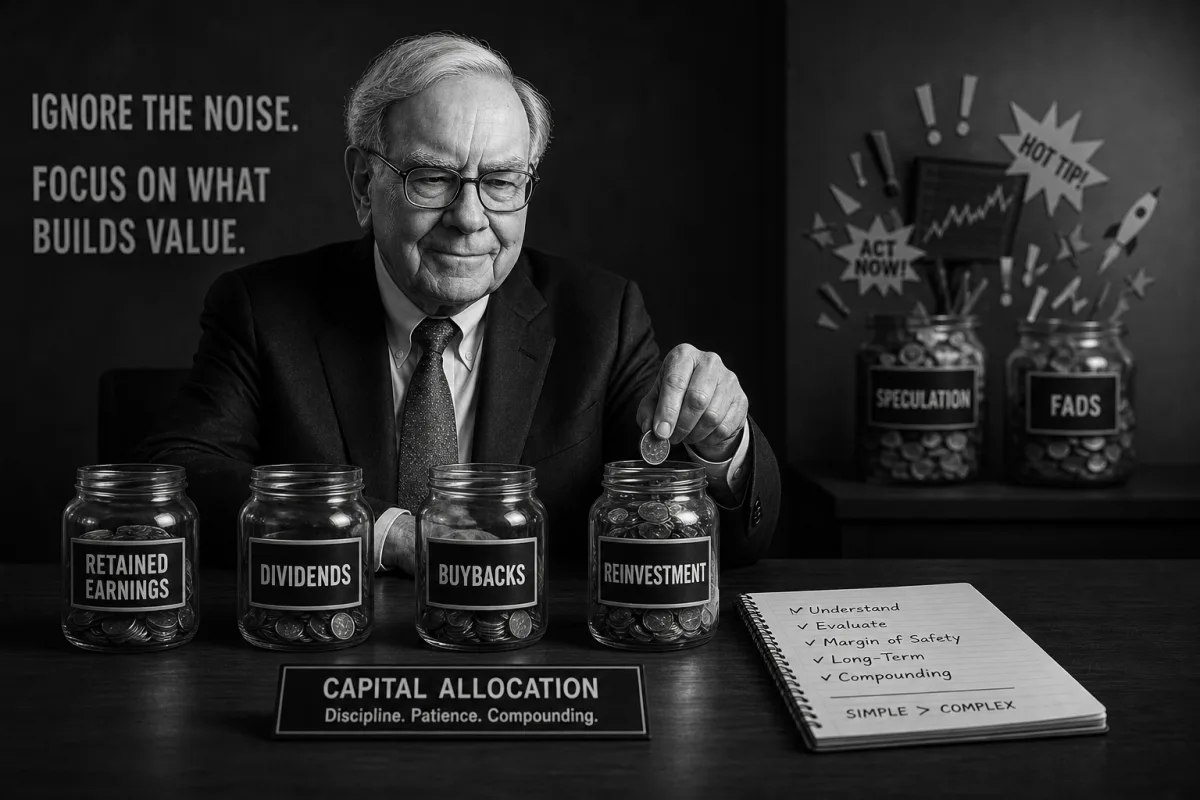
Buffett on capital allocation
For forty years, Warren Buffett has been making the same quiet argument about the CFO function, and most CFOs still haven’t fully internalised it.
The argument runs roughly like this. The single most consequential thing finance does is decide how every retained dollar gets deployed — into operations, into acquisitions, into the share count, into investments, into the balance sheet. Over a CFO’s tenure that decision compounds into more economic value created or destroyed than every other finance activity combined. And yet most finance functions spend the bulk of their training and management attention on close cycles, controls, FP&A storytelling, and investor communications — the visible job — while treating capital allocation as a once-a-year budgeting exercise or a deal-by-deal episode.
Three Berkshire letters — 1984, 1987 and 2014 — together lay out a discipline most CFO functions don’t have. They are worth reading in sequence.
The one dollar test (1984)
Buffett’s first principle is simpler than the literature around it suggests:
Unrestricted earnings should be retained only when there is a reasonable prospect — backed preferably by historical evidence or, when appropriate, by a thoughtful analysis of the future — that for every dollar retained by the corporation, at least one dollar of market value will be created for owners.
— Buffett, 1984 letter
Strip out the qualifiers and the test is this: every dollar the company keeps is implicitly a claim that the firm has a better opportunity for that dollar than the shareholder does. If you can’t make that claim with evidence, the dollar belongs to the owner.
For a CFO, this reframes nearly every finance decision. Capex is a one-dollar-test decision. Working capital build-up is a one-dollar-test decision. Tuck-in M&A is a one-dollar-test decision. So is the choice not to repurchase shares, not to pay a special dividend, not to delever. Each of those is a quiet capital deployment by default — and Buffett’s test asks whether the firm has earned the right to make it.
What’s striking is how few internal capital cases are written this way. Most read as this project earns more than our hurdle rate, which is not the same question. The hurdle rate is internal. Buffett’s test is external. The relevant comparator is what your owner could earn with the dollar if you sent it back.
The accidental capital allocator (1987)
Three years later, Buffett identified the structural reason most companies fail this test.
Most bosses rise to the top because they have excelled in an area such as marketing, production, engineering, administration or, sometimes, institutional politics. Once they become CEOs, they face new responsibilities. They now must make capital allocation decisions, a critical job that they may have never tackled and that is not easily mastered.
— Buffett, 1987 letter
And the number that should sit on every CFO’s wall:
After ten years on the job, a CEO whose company annually retains earnings equal to 10% of net worth will have been responsible for the deployment of more than 60% of all the capital at work in the business.
— Buffett, 1987 letter
That sentence is the entire job. Sixty percent of a company’s invested capital base, within a single CEO’s tenure, was allocated by the current management team. Not inherited from a founder. Not granted by a board. Not constrained by industry economics. Chosen — one retention decision at a time, every quarter, every approval, every “let’s keep the cash and see what comes up.”
The accidental nature of this is not a CEO problem. It is a finance problem. The CEO sets direction. The finance function is the institutional memory and framework keeper that turns that direction into a sequence of disciplined dollar-by-dollar choices. If the CFO function does not own the rigor of capital allocation, no one else will — and the accidental version of the job is the one that happens.
The 2026 update on this is uncomfortable. AI has lowered the cost of the visible parts of finance: close, reporting, scenarios, narrative. It has not lowered the cost of judgement. The CFO who treats capital allocation as the central craft is the one whose function still has a reason to exist a decade from now.
Five paths, not one decision (2014)
In the 50th-anniversary letter, Buffett laid out how Berkshire actually puts capital to work:
Charlie and I hope to build Berkshire’s per-share intrinsic value by (1) constantly improving the basic earning power of our many subsidiaries; (2) further increasing their earnings through bolt-on acquisitions; (3) benefiting from the growth of our investees; (4) repurchasing Berkshire shares when they are available at a meaningful discount from intrinsic value; and (5) making an occasional large acquisition.
— Buffett, 2014 letter
The list looks unremarkable until you notice what it actually is. It is not five strategies. It is a taxonomy. Every dollar Berkshire retains will travel down exactly one of those five paths — and Buffett’s discipline is to weigh each retention dollar against all five, every time.
Most finance functions don’t do this. They are good at one or two paths and treat the rest as exceptions. A growth-stage company is fluent in (1) and maybe (2), and treats (4) as a CFO-IR conversation that happens once a year. A mature company is fluent in (4) and quietly defaults to (1) for everything else because that’s what the operating P&L absorbs. A holding-company structure is fluent in (5) and undervalues (3). In each case the institution has, in effect, pre-decided where dollars go. The retention test stops getting asked.
The buy-side version of this same idea is portfolio rebalancing — you can’t be a passive holder of any one path. The cost of being undisciplined isn’t that you make a bad decision; it’s that you make a non-decision that gets reported as a decision in retrospect.
For the CFO, the practical move is to make the taxonomy explicit in every retention case. State which of the five paths the retained dollar will travel. State why that path beats each of the other four for this specific dollar. State the test that will tell you, in three years, whether the choice was right.
That is more rigour than most boards currently demand. It is also the only way the one-dollar test ever gets enforced.
What this means for a 2026 CFO
The three letters compound into a small set of working principles that translate directly to the finance function:
- Every retention decision is a capital allocation decision. Whether you call it capex, working capital, deleveraging, or “carry the cash” — Buffett’s test applies to all of them with equal force.
- The hurdle rate is the wrong comparator. Internal hurdle rates measure whether the project clears your cost of capital. They do not measure whether the project beats the owner’s best alternative. Both have to clear.
- Capital allocation belongs in the CFO function, not as a quarterly artefact of the planning cycle. Owning the framework — what counts as a retention decision, which path each one travels, how the one-dollar test is audited ex post — is the work.
- Treat the five paths as a portfolio. Build fluency in all five before the strategic moment demands one. The CFO who has never run a real buyback evaluation will not run a good one under pressure.
None of this is new. The 1984 letter is forty years old. The 1987 letter is thirty-eight. The 2014 letter is more than ten. The vocabulary of finance has changed in that time. The discipline has not.
If the CFO function in 2026 has an under-rehearsed muscle, this is it.